Thursday, January 30, 2014

Historical Sew Fortnightly Challenge #2 Innovation


The Challenge:  Innovation
Fabric:  Cotton
Pattern:  Past Patterns #8159 Ladies' Dress with Two Piece Skirt, Documented to Novemer 1917
Original Pattern:  McCall Pattern No. 8159 Patented April 21, 1908  20 cents
Year:  1908 - 1917
Notions:  Buttons, Snap Fasteners
How historically accurate is it?  The pattern and sewing techniques are historically accurate.  The use of the Downton Abbey print is, of course, not accurate, but the use of cotton fabric is accurate.  So.....90%?
Hours to complete?  16 hours
First Worn:  Made for the Downton Abbey Costume Exhibition at Winterthur Museum, Spring 2014.
Total Cost:  Buttons $3.52, Pattern $16.00, Fabric $50.00 = $69.52


Creativity is thinking up new things.

Innovation is doing new things.
     Theodore Levitt


It started with a hat.  It always starts with something small, doesn't it?  A photo, a drawing, a dream, a thing - that first part of creating.  A stop at a local flea market/antique shop just after Christmas and this hat caught my eye.  It had the most beautiful turquoise thread and being just $3.00 it came home with me.  I had a colorful scarf which I thought would make a fun addition and I could wear it in the summer.


But then I remembered seeing a great dress pattern that I had once thought would be perfect for the Downton Abbey Costume Exhibition at the Winterthur Museum next spring.  A little internet searching and I found the pattern on the Past Patterns website.  Yay!  And what kind of hat was being worn in the inspiration?  One just like my $3.00 beauty!  I wanted a nice cotton for this dress and discovered that a new line of quilting cottons had been released in the Downton Abbey theme.  Another search and I found a 4 yard piece on ebay for $50.00.  It wasn't enough to make the dress but I had a tiny piece of contrast fabric in my stash that I thought would coordinate and luckily it did.


The pattern is one-sized and I would have to rescale it to fit me.  Something I'm not experienced doing.  So I cut the pattern and pinned the paper pattern pieces to my dressform.  This gave me a general idea of the construction of the dress and where I would need to add to the pattern's dimensions. 


Some measuring, some additions, some mistakes, some corrections, and several mock-ups later I have done it!  Of course I'm thrilled that I figured this out and did this!


Before I start to cut the fashion fabric I start a little side project for my hat decoration.  This is 1-1/2" wired ribbon and Tulip Soft Fabric Paint in turquoise.  I mix some of the paint with water, dip my coiled ribbon in it until I get the saturation I want and then let it dry in a glass bowl.

 
It turns out to be a beautiful variegated ribbon.....
 
 
which I sew into a turquoise Tea Rose.


So back to creating the dress.  I had to be very very careful with my cutting as I wanted the "Abbey" part of the pattern situated on the center of the back and bodice, the center of the skirt front, and the center of the sleeves.  To do this I cut each piece individually and then laid the cut piece on the fabric with right sides facing and mirrored the pattern.


I had inches of fabric to spare!  And in my rescaling and pattern matching I made a terrible error.  I was short fabric on the left bodice front shoulder and cut into my fabric on the right bodice front shoulder.  Oh no!  These pieces would be so visible and I had no fabric left over!


To fix my mistakes I cut pieces from my contrast fabric and created strips across the tops of the shoulders.  They actually turned out to be a nice addition to the design.  


Now we get to the Innovation.  Snap Fasteners!  In the directions Item (2) says "fasten with snaps."  It is referring to the bodice pieces as they overlap each other.  A snap fastener is a pair of interlocking discs made of metal, or today of plastic, and used to fasten clothing.  Like buttons, the concept is actually ancient and a form can be traced back to 210 BC on horse halters.  The modern snap fastener was first patented by German inventor Heribert Bauer in 1885 as the "Federknopf-Verschluss".  It was a fastener for men's trousers.  The invention was sold to a German company in 1903 who started production and marketing that year.  Prym is still the leading European producer of snap fasteners.  When James McCall patented his dress design and pattern in 1908, the snap fastener for a ladies' dress would have been a wonderful innovation that had become mainstream in a few short years.


In my fastener inventory I had the snap studs which became popular in the 1930's by rodeo cowboys for quick release of their shirts for safety, snap fasteners which attach with metal teeth, and clear sew-on snap fasteners.  While the clear snap fasteners would not have been available in 1908, the sew on method was very period correct for this dress.


A touch of contrast fabric, a touch of turquoise with buttons, and the Downton Abbey dress is complete!


Although the Exhibition is months away, I couldn't resist having a little photo fun with my new creation!
 
 
Love,
            Jeanette

Wednesday, January 15, 2014

Historical Sew Fortnightly Challenge #1 Make Do and Mend


The Challenge:  Make Do and Mend
Fabric:  Silk Dupioni and Taffeta
Pattern:  Butterick B4698 Making History Designed by Rachel Wallis
Year:  1872
Notions:  6 yards 2-1/2" lace, 6 yards trim, 3 yards ribbon for waistband
How historically correct is it?:  Based on fashion plates and period photographs, I believe this collar would have been used as an alternate to extend the use of a gown.
Hours to complete?:  4 to 6 hours depending on whether the wide lace is pre-gathered or it requires self gathering or pleating as was done for this challenge.
First worn:  Planned for a spring dinner party.
Total Cost:  Part of this challenge was my personal challenge to "Make Do" with what was available and therefore there was no additional cost except thread.  Everything was left over from the original ball gown construction or other projects.

Do what you can, with what you have, where you are.
                                                  Theodore Roosevelt
 

This project started with a ball gown completed in December 2013.  It was for a Reconciliation Ball and the colors were blue and gray representing the colors of the armies of the North and South during the Civil War.  The amount of material required for the pleating meant that there was little left to make another bodice to extend the wear of the gown to other events.


The bodice bertha is constructed so that it slips over the head and ties to the bodice.  That gave some options for adding lace and trims to the bodice for a different look but it is still only suitable for a ball gown due to the off-the-shoulder style.


The book Victorian Costumes for Ladies 1860 - 1900 by Linda Setnik is actual photographs and a great historical resource.  This gown looked like it was a ball gown and the description says that a chemisette has been added.  There are cap sleeves and it appears that long sleeves could have also been added.


This Butterick pattern View B seemed to offer a way to Make Do with the remaining fabrics and bring added use to the ball gown.


So I gathered my small supply of leftover fabric and cut the pieces...
 
 
flatlined the front panels, the back, and the collar with muslin, and box-pleated lace for all edges.


There were several choices of trim in my little stash and I posted the photos on facebook and let my friends choose.  Dusty pink, navy/gray, white with blue roses, and white gimp.


And the winner is.....  the navy/gray!   And here is the finished collar over the ball gown bodice and the skirt with the pansy ribbon flowers.


While this gown is suitable for another ball it could easily be used for an opera gown, or a dinner gown (which is my plan!).  Here is the gown without the ribbon flowers.
 
 
Just as we try to mix and match and extend our wardrobes today, I believe Victorian ladies were creative and learned to Make Do when they ran out of fabric, when gowns were passed to sisters and cousins, and when a special gown needed a facelift.
 
 
Love,
               Jeanette


Thursday, April 7, 2011

The Perfect Touch Parasol


Live in the sunshine.
                                            - Ralph Waldo Emerson


Summer and sunshine are almost here!  And while I love wearing fun wide-brimmed hats to keep the sun off my face, I know that once that hat is on my head, it must stay there for the rest of the day.  I am prone to severe cases of that dreaded affliction - Hat Hair!  So I was thinking about the Victorian ladies and their porcelain complexions protected by their ever beautiful parasols and an idea came to me - a custom parasol cover!

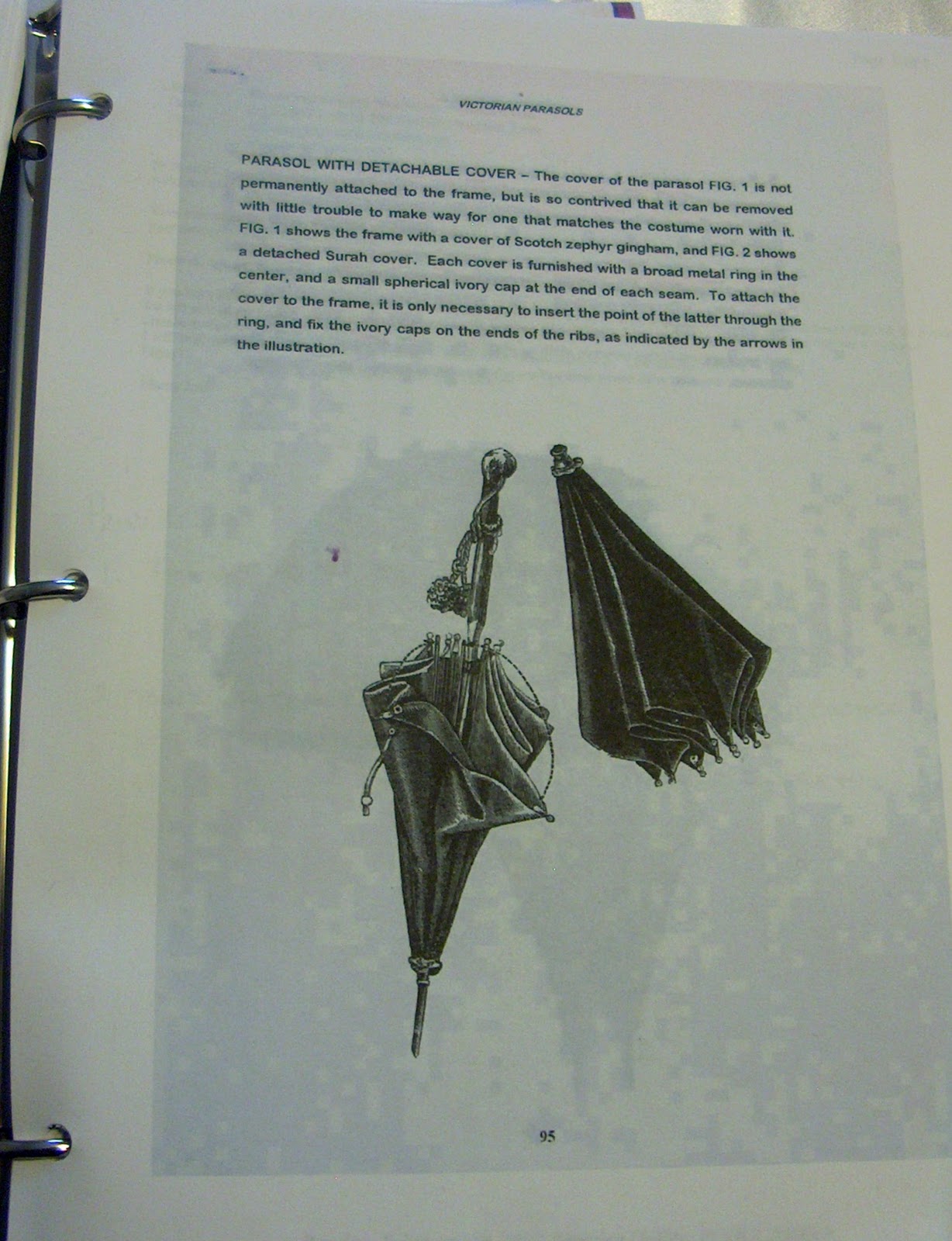
Now changeable parasol covers is not a new idea.  This was shared with me by my dear friend Kathleen Henderson:  "Victorian Parasols.  Parasol with detachable cover - the cover of the parasol Fig. 1 is not permanently attached to the frame, but is so contrived that it can be removed with little trouble to make way for one that matches the costume worn with it.


Fig 1 shows the frame with a cover of Scotch zephyr gingham, and Fig 2 shows a detached Surah cover.  Each cover is furnished with a broad metal ring in the center, and a small spherical ivory cap at the end of each seam.  To attach the cover to the frame, it is only necessary to insert the point of the latter through the ring, and fix the ivory caps on the ends of the ribs, as indicated by the arrows in the illustration."

But I am thinking it would be wonderful to have several covers for my parasol that would just tie on. And  wouldn't it be more wonderful to have a reversible cover?  So I've purchased two coordinating fabrics - 1-1/2 yards of 45" wide of each fabric, two rolls of coordinating 3/8" grosgrain ribbon, a 1/4" grosgrain ribbon to match the base parasol color, and 2 yards of lace.

This is a standard 'sutler' parasol which can be purchased at most costuming websites.  They come in many colors and have wooden handles.  They are a small, personal, size so that even in a crowd you can give yourself shade without taking up too much space.

This is a pattern for one panel of the sutler parasol.  Since we don't need perfection for this cover like you would for an actual parasol, you can make this pattern by laying clear plastic wrap over your parasol, outlining with a Sharpie, and then adding a seam allowance.  This pattern is cut from pattern saver so I can see exactly how I want to place the fabric design on my parasol.

And the first panel is cut.

To keep the same pattern on all remaining panels I use the first cut panel as my new pattern aligning the pattern on the fabric.

See how the pattern aligns closely?  Not perfect, but close.  Remember, this is supposed to be fun!

Now I have two panels.  Using the first fabric panel you cut, repeat until you have six panels.

When sewing the panels for a parasol you can use a 'parasol seam' which is very strong.  Pin your fabric about 3/4" from the edge.  Fold over about 1/4" (I usually press this fold), and sew close to the raw edge through all four layers.  Press each seam flat to integrate the thread into the fabric, then press open.  Repeat for 5 seams.  Note:  The sewing ends about 1" from the top to leave room for the parasol ferrule.  On my next pattern I will cut off the pointed tip.

On your final seam cut a 2" piece of ribbon, fold in half, and sew into the seam about 3" from the outside edge.  This will be a loop to hold your closure ribbon.

Now you have a parasol cover and you can see the circular pattern created when you matched your panels.

Since you really don't need the strength of the parasol seam on this cover you can also sew a French seam by adding 1/8" of fabric on the right and left side of the pattern.

Sew the seam with wrong sides together. (here is the loop for your closure tie)

Turn the fabric right sides together and sew the seam again.  This is a nice finished seam if you are creating a cover with a single side.

Six panels sewn together with a closure loop in one seam.

I've cut 6 12" pieces of each of the two colors of 3/8" grosgrain ribbon and pinned them to each corner of the cover.

On one parasol cover side I pinned my 6 tie ribbons and then the lace.  I stitched the lace to this cover side...

and then when I stitch both sides together I can just follow the first stitching from sewing on the lace.

After stitching the entire outer edge and then pressing the seam to integrate the thread into the fabric, I turned the cover right side out and pressed again.  I turned the edges in at the ferrule opening and added a loop for a ribbon tie around the ferrule and blind stitched the two halves together.

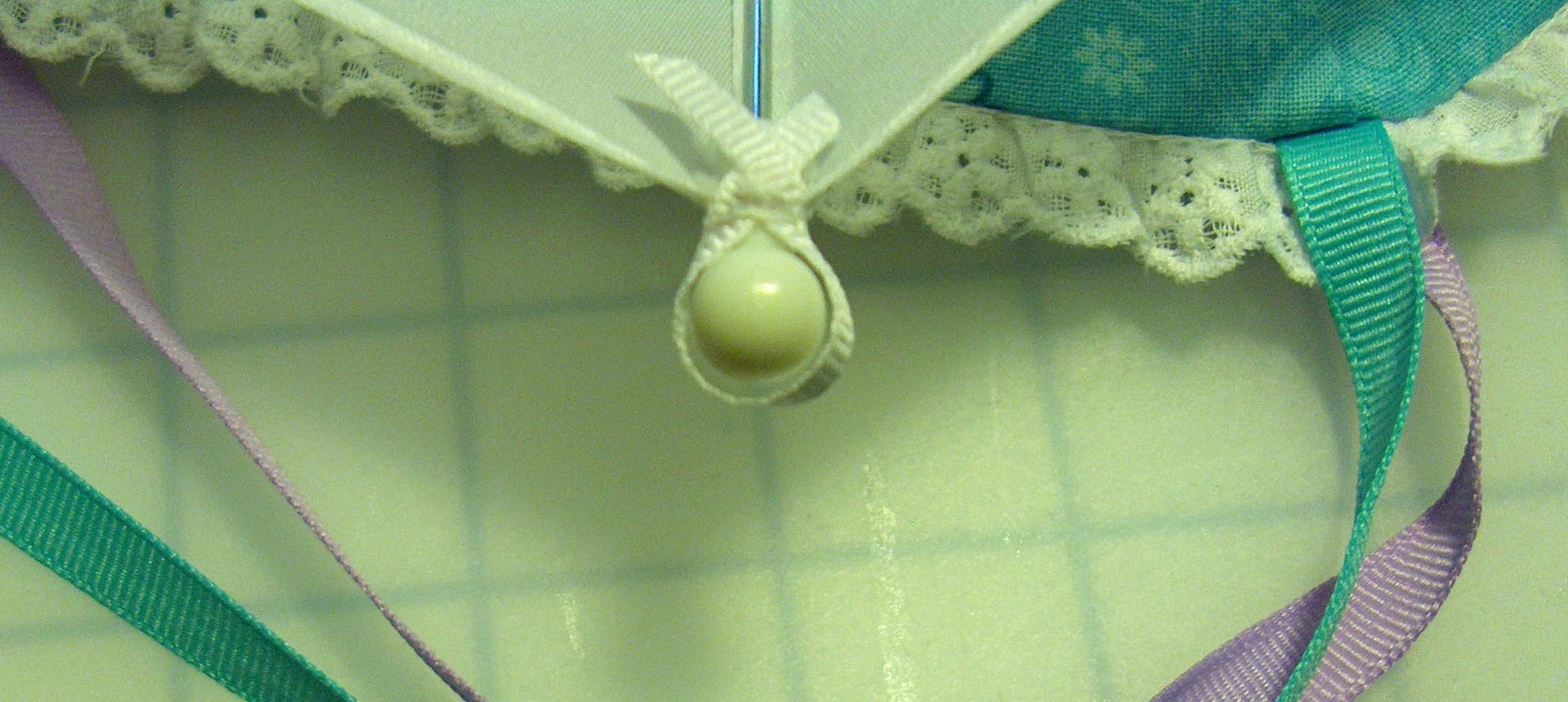
This is a 2" piece of the 1/4" grosgrain ribbon sewn through the same holes that hold the base parasol to the rib tips.

Thread one of the cover ties through the loop...

and make a knot and bow.  Repeat for the other 5 rib tips.  Cut a 12" piece of 3/8" grosgrain, thread through the loop in the center of the cover, and tie around the ferrule.  (Note:  I tied the cover onto the parasol loosley before opening the parasol.  This cover is not meant to be tight.)

And....tada!  A custom cover for my parasol!

This is the parasol closed and tied with a 24" piece of 3/8" grosgrain threaded through the loop you placed near the outer edge.  This closure tie can be tied in a bow when the parasol is open.

And when the cover is removed and reversed, an entirely different parasol!

Two, two, two parasols in one!  (That's taken from an old advertising line.)

The purple and blue colors are the colors of the March of Dimes.  I made this parasol as a fund raiser for The Perfect Touch website.  This baby's toy has wings that light and it plays Twinkle, Twinkle Little Star when you press its tummy.  The toy will be included with the parasol in the fund raiser.

I hope you have enjoyed my idea and will be inspired to make some beautiful parasol covers of your own!


With Love,


May 6, 2011  A month has passed since I posted this tutorial and placed The New Beginnings Parasol on The Perfect Touch website.  My husband and I were thrilled that his daughter was expecting her first baby - the first grandbaby.  Science has given us such amazing tools to look into the future of our unborn and, sadly, at times that future is less than we would want for our children and grandchildren.  Today the little one my husband and I had already come to love had to leave this life because of serious complications.  The mission of The March of Dimes is to continue research into complications such as these and I am thankful for their work.